

Hardware Security Modules
Make the right HSM decision for your organisation




Why
A hardware security module (HSM) is a dedicated, tamper-resistant physical device that generates, stores and manages cryptographic keys within a hardened security boundary. Unlike software-based key storage, an HSM ensures private keys never leave the protected hardware environment. It provides the highest level of assurance for organisations that depend on digital trust.
An HSM is also one of the longest-lived infrastructure decisions an organisation makes, often remaining in service for a decade or more. The wrong choice is rarely visible on day one. It surfaces later as:
- Vendor lock-in: proprietary key formats and tooling that make later migration costly and risky.
- Compliance exposure: certification and sovereignty requirements missed at selection, which are difficult to retrofit.
- Performance ceilings: throughput and partition limits that constrain growth as certificate volumes rise.
- Obsolescence: devices that cannot adopt post-quantum algorithms as standards land.
- High-risk migrations: end-of-life hardware, with keys, applications and key ceremonies that nobody has revisited in years.
Unsung delivers end-to-end HSM services, from requirements and independent vendor selection through architecture design, deployment, migration and ongoing operational support. Our vendor-certified consultants work across Thales, Entrust, Crypto4A, Fortanix and Futurex platforms. We serve government, defence, financial services and enterprise clients across the United Kingdom. We hold no allegiance to any one vendor.
Speak to an HSM specialist | Download the HSM Buyer's Guide
What Is a Hardware Security Module?
A hardware security module (HSM), often called an HSM module, is a purpose-built cryptographic appliance. It performs key generation, digital signing, encryption and decryption within a physically protected enclosure. HSMs are engineered to be tamper-resistant and tamper-evident. If someone attempts to access the internal components, the device detects the intrusion and automatically destroys (zeroises) the keys it holds.
HSMs are validated against internationally recognised standards: FIPS 140-3, its predecessor FIPS 140-2, and Common Criteria. Level 3 validation, the enterprise norm, requires:
- physical tamper-resistance mechanisms
- identity-based authentication for all operators
- separation between the interfaces through which critical security parameters enter and leave the module
FIPS 140-3 is now the current standard. FIPS 140-2 certificates moved to NIST's historical list in September 2026, so new procurements should look for FIPS 140-3 validation.
The fundamental difference between an HSM and software-based key storage is the security boundary. Keys stored in software, whether on a server's file system, in a database or in a virtual machine, are exposed to the same attack surface as the operating system and applications around them. A compromised server means compromised keys. An HSM creates an isolated environment where keys are generated and used but never exported in plaintext. This sharply reduces the risk of key compromise and gives auditors clear evidence that it cannot happen.
Modern HSMs support a wide range of cryptographic algorithms, including:
- RSA
- ECC (elliptic curve cryptography)
- AES
- increasingly, NIST post-quantum algorithms such as ML-DSA and ML-KEM
They serve as the trust anchor for public key infrastructure (PKI), certificate lifecycle management, code signing, payment processing and digital identity systems.
What
Unsung's HSM Services
Unsung is a specialist HSM and PKI consultancy. We deliver hardware security module services across the full lifecycle, from the first requirements conversation to day-to-day operations.
- HSM strategy and independent vendor selection: We define your requirements, weight them for your environment and assess the options on their merits. You receive a clear recommendation with transparent reasoning, not a vendor's preference. This covers deployment model selection, certification requirements and total cost of ownership over the life of the device.
- Architecture and design: High-level and low-level design documentation covering high availability, partitioning, network placement, role separation and disaster recovery. The design is built around your assurance framework, not retrofitted to it.
- HSM deployment: Physical installation, network configuration, partition creation, key ceremony facilitation and application integration, delivered by specialists who have run ceremonies in highly assured environments.
- Integration: We connect your HSMs to the systems that depend on them, including ADCS, EJBCA, certificate lifecycle management platforms, code signing and enterprise key management, so the HSM delivers value from day one.
- HSM migration: Moving from legacy or end-of-life HSMs to current platforms, including key migration, application reconfiguration and validation testing. We plan migrations to keep services running and keys protected throughout. Where key material is non-exportable, we design the regeneration and reissue path.
- Operational support and managed service: Ongoing HSM management, firmware updates, partition administration, backup and recovery procedures, and incident response. This keeps your estate compliant, resilient and current. See PKI Management & Hosting.
- HSM health checks: An independent review of your existing estate covering firmware and certification currency, configuration, ceremony records, backup and recovery, and readiness for post-quantum cryptography. See PKI Health Check.
- Training: Hands-on HSM administration training for your internal teams, covering key ceremonies, backup procedures and day-to-day operations.
Whether you need a single HSM for an offline root CA ceremony or a multi-site, high-availability HSM estate supporting enterprise PKI, our team can help.
Our Approach to HSM Selection
There is no single best HSM. The right device depends entirely on the environment it will serve, so we work in three steps.
- Define requirements. Assurance level, deployment model, workload type and the regulatory frameworks that apply to you.
- Weight by environment. A high-assurance national infrastructure site weights criteria very differently from a payment service provider.
- Match to the right device. We score candidate devices against your weighted requirements and show our reasoning, so the recommendation can be independently assessed.
Every option is assessed against eight criteria:
- Assurance and certification: FIPS 140-3 or 140-2, the level achieved, Common Criteria EAL and eIDAS.
- Deployment and form factor: network appliance, PCIe card, modular blade or USB, and the high-availability implications of each.
- Performance and scale: signing throughput, partition density and behaviour under sustained load.
- Payment or general purpose: PCI PTS HSM validation, general key and certificate use, or both.
- Integration and ecosystem: PKCS#11, KMIP, REST, OCSP, SQL TDE, ADCS and EJBCA.
- Post-quantum readiness and crypto-agility: native ML-KEM and ML-DSA support, and the ability to adopt new algorithms without a hardware refresh.
- Operational model: key ceremony complexity, administrative overhead, role separation and the skills required.
- Commercial and total cost of ownership: licensing, partition pricing, support and migration cost over the life of the device.
Download the HSM Buyer's Guide for the full framework, or read our vendor-by-vendor guide to choosing a hardware security module.
HSM Architecture and Deployment Models
Choosing the right HSM deployment model depends on your organisation's:
- performance requirements
- regulatory obligations
- infrastructure strategy
- long-term cryptographic roadmap
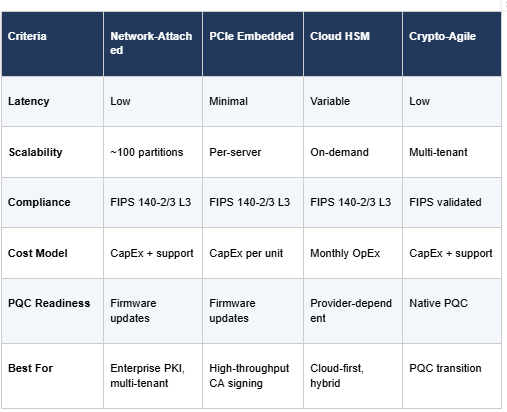
There are five primary deployment models. Each has distinct advantages and trade-offs.
Network-Attached HSMs
Network-attached HSMs, such as the Thales Luna Network HSM 7, are standalone appliances connected to your data centre network. They support around 100 isolated partitions. This enables multi-tenant separation, where different applications, teams or clients share a single physical device without accessing each other's keys. Network HSMs are the most common deployment model for enterprise PKI, offering high-availability configurations and centralised management.
Partition capacity and licensing deserve close attention at design stage. Partition counts typically grow as applications are onboarded, so the licensing model should be understood before the business case is approved.
PCIe Embedded HSMs
PCIe HSMs, such as the Thales Luna PCIe HSM 7, are installed directly into a server's expansion slot. They remove the network hop between the application and the cryptographic module, which gives minimal latency and maximum throughput. They suit:
- high-volume transaction processing
- certificate authority (CA) signing operations
- other performance-critical workloads where every millisecond matters
The trade-off is that the HSM is bound to its host. Availability and capacity planning must account for that.
USB and Backup HSMs
Small form factor USB HSMs and dedicated backup HSMs are used to:
- protect offline root CA keys held in secure storage
- securely back up and restore key material
- seed new clusters
- provide disaster recovery
They are typically deployed alongside network or PCIe HSMs rather than instead of them.
Cloud HSMs
Cloud HSM services, including Thales Luna Cloud HSM and Futurex VirtuCrypt, deliver hardware-grade key protection without on-premises infrastructure. Keys remain in dedicated hardware, but the service is consumed on a subscription basis.
Cloud HSMs suit organisations that:
- are pursuing cloud-first strategies
- run hybrid environments
- need to scale cryptographic capacity without capital expenditure on physical appliances
Key custody, data residency, single-tenancy arrangements and exit provisions should all be examined before committing.
Crypto-Agile HSMs
Crypto-agile HSMs, such as the Crypto4A QxHSM, are purpose-built to support both classical and post-quantum algorithms natively. As organisations prepare for the transition to post-quantum cryptography (PQC), crypto-agile HSMs provide a foundation that avoids costly hardware replacement when new algorithm standards are mandated.
Deployment Model Comparison
HSM Use Cases
Hardware security modules underpin the most critical trust operations across government, financial services, defence and enterprise environments. Below are the primary use cases where HSM protection is either mandated by regulation or considered essential best practice.
PKI Root and Issuing CA Key Protection
The private keys of root and issuing certificate authorities are the foundation of your entire PKI trust chain. If a CA key is compromised, every certificate it has issued becomes untrustworthy, and recovery means rebuilding trust across every system that relies on it.
HSMs protect these keys within FIPS 140-3 Level 3 or FIPS 140-2 Level 3 validated hardware. This ensures they are generated, stored and used exclusively within the secure boundary. Offline roots are commonly held on USB or backup HSMs in secure storage, with issuing CAs on network-attached HSMs in a high-availability configuration.
Unsung has delivered highly assured PKI root deployments for government and enterprise clients. HSM-backed key protection is a core component of every PKI Design & Build engagement.
Code Signing Key Management
Software supply chain security depends on the integrity of code signing keys. Storing signing keys on developer workstations or shared network drives creates unacceptable risk. A stolen signing key lets an attacker distribute malicious software that appears legitimate.
HSMs centralise signing key storage with strict access controls, workflow approvals and comprehensive audit trails. Unsung implements HSM-backed code signing using Keyfactor Enterprise Code Signing and Keyfactor Signum, for on-premises and cloud-hosted environments respectively.
Payment Transaction Processing
Payment processing relies on a distinct category of device. Payment HSMs:
- are certified under PCI PTS HSM
- perform PIN translation, PIN verification, card verification and EMV processing natively within a certified security boundary
- never expose a PIN in the clear outside the device
General-purpose HSMs are typically validated to FIPS 140-3 and Common Criteria rather than PCI PTS HSM. They protect keys for PKI, code signing and database encryption.
The two answer different requirements, and one does not substitute for the other in a PCI PIN or PCI DSS assessment. Most organisations in financial services need both, and treating them as a single procurement is a common and expensive mistake. Read more in Payment HSMs: meeting DORA, PCI DSS and FIPS 140-3.
Digital Signature Generation
Qualified electronic signatures under eIDAS and other regulatory frameworks require that signing keys are held within a qualified signature creation device. HSMs fulfil this requirement. They generate signatures within a tamper-resistant boundary and ensure the signatory retains sole control of their key. Remote signing platforms integrate with HSMs to enable server-side signing with strong authentication.
Key Management for Encryption at Rest
Encrypting data at rest is only effective if the encryption keys themselves are properly protected. HSMs provide a root of trust for key management systems, protecting the master keys that encrypt and decrypt data encryption keys. With this layered approach, data remains inaccessible even if storage media is compromised, unless the attacker also has access to the HSM-protected master key.
Platforms such as Fortanix Data Security Manager and Cryptomathic CKMS integrate with HSMs for enterprise key management.
Knowing which keys exist, where they are stored and which systems depend on them is a prerequisite for effective key management. A Cryptographic Bill of Materials (CBOM) provides this visibility. It maps cryptographic assets across your estate so that HSM-protected keys can be prioritised by sensitivity and business impact.
IoT Device Identity Provisioning
As organisations deploy thousands or millions of connected devices, each device needs a unique cryptographic identity. HSMs generate and protect the keys used to provision device certificates at scale, ensuring each identity is created within a trusted environment. This is particularly critical in transport, energy and defence, where compromised device identities could have safety-critical consequences.
HSMs and Key Management
An HSM protects keys. Key management governs them. Most organisations need both, and problems usually start in the gap between the two.
Key protection is about where a key lives and who can use it. An HSM provides this by keeping keys inside a certified boundary and enforcing access controls on every operation.
Key management covers the full lifecycle: generation, distribution, rotation, backup, recovery, retirement and destruction. It applies to keys wherever they sit, including HSMs, cloud key management services, databases and applications.
The common problems we see are:
- Keys held in several HSMs, clouds and applications with no single record of what exists.
- Rotation that depends on individuals rather than policy.
- Backup and recovery procedures that have never been tested.
- No clear owner for keys protecting critical services.
We help organisations put this right. That covers key management policy, platform selection, integration with HSMs and cloud services, key ceremonies and documented recovery. Where a central platform is needed, we work with options such as Cryptomathic CrystalKey 360 and Fortanix Data Security Manager, selected on your requirements.
A Cryptographic Bill of Materials shows which keys you have and where they are, which is the starting point for both.
How
HSM vs Software Key Storage
Organisations frequently ask whether they truly need dedicated HSM hardware, or whether software-based key storage is sufficient. The answer depends on:
- the sensitivity of the keys
- regulatory requirements
- the organisation's risk appetite
The table below gives a direct comparison.
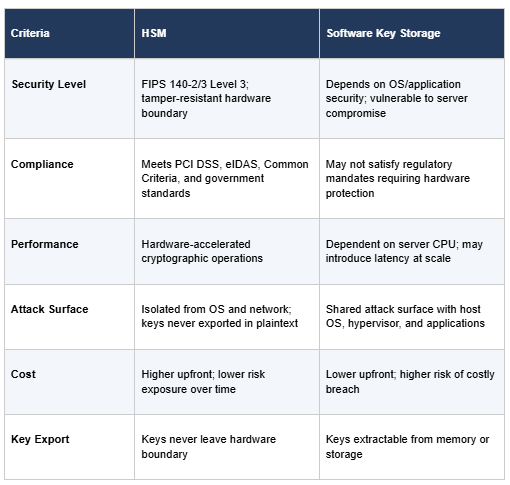
For some keys, an HSM is not optional. It is a baseline security requirement. These include:
- root CA keys
- payment processing keys
- qualified signing keys
- any key material where compromise would have catastrophic consequences
For less sensitive use cases, software key storage with robust access controls may be acceptable. Organisations should document that risk decision formally, so it can be evidenced to auditors and revisited as the estate changes.
Vendors We Work With
Vendor-Certified Expertise
Our consultants hold current vendor certifications across the HSM platforms we deploy, alongside ITIL operational qualifications. This is not theoretical knowledge. Our team has hands-on implementation experience with each product in production environments across government, defence, financial services, healthcare and critical national infrastructure.
HSM Partnerships
Unsung holds formal partnerships with leading HSM vendors. These give our clients priority technical support, early access to new capabilities, and consultants with deep product knowledge. Partnerships do not shape our recommendations. We disclose them so the basis of any recommendation can be independently assessed.
- Thales: Gold Partner (5+ years). Luna Network HSM 7, Luna PCIe HSM 7, Luna USB and Backup HSMs, and Luna Cloud HSM. This is our longest-standing HSM partnership, with deep expertise across the full Luna product family. Recent Luna 7 firmware adds post-quantum support through functionality modules.
- Entrust. nShield 5, validated to FIPS 140-3 Level 3 and Common Criteria EAL4+. Its container architecture and in-HSM code execution suit identity-led enterprise PKI.
- Crypto4A: Bronze Partner. QxHSM, validated to FIPS 140-3 Level 3. Quantum-safe, crypto-agile HSMs on a modular blade architecture, for organisations preparing for the post-quantum transition.
- Fortanix. Data Security Manager (DSM), Armor and Confidential Computing Manager. A software-defined, cloud-first platform backed by the FX2200 FIPS 140-2 Level 3 appliance and Intel SGX. It unifies on-premises and cloud keys from one interface.
- Futurex. CryptoHub, VirtuCrypt and the Classic Enterprise Platform. On-premises and cloud HSM solutions for payment processing, PKI and enterprise key management on a converged platform.
We also assess Utimaco, IBM and Securosys as part of independent selection, where European sovereignty, Level 4 assurance or mainframe integration is a requirement.
Government and Defence Clearance
Our team includes Security Check (SC) and Developed Vetting (DV) cleared consultants. This enables us to work on classified programmes and within secure government environments. We have delivered HSM and PKI projects for UK central government departments and defence organisations where security clearance is a prerequisite for access.
HSM and PKI Case Studies
- Delivery of a highly assured PKI root
- A strategic approach to obsolescence remediation
- Migration de-risking
Choosing an HSM? Download the Buyer's Guide
Our independent, vendor-neutral HSM Buyer's Guide covers:
- the eight criteria that decide HSM fit
- a weighted requirements framework
- a comparison of eight leading hardware HSM vendors: Thales, Entrust, Utimaco, Futurex, Crypto4A, IBM, Securosys and Fortanix
Download the free HSM Buyer's Guide
Explore our wider PKI Consultancy and PKI Management & Hosting services.
Frequently Asked Questions
What is a hardware security module?
A hardware security module (HSM) is a dedicated, tamper-resistant physical device that generates, stores and manages cryptographic keys within a hardened security boundary. HSMs are validated to standards such as FIPS 140-3, FIPS 140-2 Level 3 and Common Criteria, ensuring that private keys never leave the protected hardware environment. They serve as the trust anchor for PKI, code signing, payment processing and digital signature systems.
What is an HSM module?
"HSM module" is a common way of referring to a hardware security module. It is a certified, tamper-resistant device that generates, stores and uses cryptographic keys. HSMs come as network appliances, PCIe cards, USB devices or cloud services.
What is the difference between key management and key protection?
Key protection controls where a key is stored and who can use it. An HSM provides this. Key management covers the whole lifecycle of a key, including rotation, backup, recovery and destruction, across every system that holds keys.
What is FIPS 140-2 Level 3, and how does FIPS 140-3 differ?
FIPS 140-2 Level 3 is a US government security standard for cryptographic modules, administered by NIST (the National Institute of Standards and Technology). Level 3 requires:
- physical tamper-resistance mechanisms that detect and respond to intrusion attempts
- identity-based authentication for all operators
- physical or logical separation between the module's interfaces
When tampering is detected, a Level 3 module zeroises all stored keys.
FIPS 140-3 is the successor standard, aligned with ISO/IEC 19790. It builds on these requirements and is now the current basis for validation. FIPS 140-2 certificates moved to NIST's historical list in September 2026. Existing deployments can continue, but new HSM procurements should look for FIPS 140-3 validation.
How do I choose an HSM vendor?
Start with your requirements, not the market. Define your assurance, performance, integration and regulatory needs, then weight them for your environment. A device that suits a payment service provider may be the wrong choice for a high-assurance government site. Our vendor-by-vendor guide to choosing a hardware security module compares eight leading vendors against the criteria that decide fit.
Which HSM is best for PKI?
It depends on your assurance requirements, CA platform and availability needs. Most PKI deployments use:
- network-attached HSMs in a high-availability configuration for issuing CAs
- offline USB or backup HSMs for root CAs
Integration with your CA software, such as Active Directory Certificate Services (ADCS) or EJBCA, is often the deciding factor.
What is the difference between a payment HSM and a general-purpose HSM?
A payment HSM performs payment-specific functions natively, such as PIN translation and EMV processing, and is certified under PCI PTS HSM. A general-purpose HSM protects keys for PKI, code signing, database encryption and key management, and is typically validated to FIPS 140-3 and Common Criteria. Most financial institutions need both.
Can HSMs support post-quantum cryptography?
Yes. Leading HSM vendors are adding support for NIST-approved post-quantum algorithms.
- Thales Luna 7: functionality modules for ML-DSA (formerly CRYSTALS-Dilithium), ML-KEM (formerly CRYSTALS-Kyber) and LMS/HSS hash-based signatures. The device must be ordered FM-ready for that upgrade path to be available.
- Crypto4A QxHSM: designed from the ground up as a crypto-agile platform, supporting classical and post-quantum algorithms natively.
The meaningful distinction is whether post-quantum support is added to an existing design or built into a crypto-agile architecture. That matters for a device that will stay in service for a decade. For more on preparing for the transition, see our guide to navigating the NIST PQC roadmap.
How much does an HSM cost?
HSM costs vary significantly with the deployment model, performance tier and vendor. As a general guide:
- Network-attached HSMs: £10,000 to £50,000+ per appliance, depending on partition count and cryptographic performance.
- PCIe HSMs: generally lower per-unit cost, but they require a compatible host server.
- Cloud HSMs: monthly subscription models, typically starting from around £500 a month.
The appliance price is rarely more than half of what an HSM estate costs. Total cost of ownership should also include:
- partition and client licences
- backup and disaster recovery devices
- annual maintenance and support (commonly around 18% of list price a year for enhanced support)
- firmware and security updates
- professional services for deployment and integration
- staff training
- the cost of migrating off the platform at end of life
Unsung provides vendor-neutral guidance on HSM selection to help you balance capability, compliance and budget. Get in touch for a tailored assessment.
Speak to an HSM Specialist
Whether you are planning your first HSM deployment, migrating from legacy hardware, or preparing your cryptographic infrastructure for the post-quantum era, Unsung's vendor-certified consultants can help.
