Certificate Management Protocols: CMP vs ACME vs EST vs SCEP
Certificate management protocols define how systems request, obtain, renew, and revoke digital certificates. Different protocols suit different use cases—what works for web server automation may not fit industrial control systems or legacy network equipment.
Understanding these protocols helps organisations select the right approach for their environment and avoid the complexity of supporting multiple protocols unnecessarily.
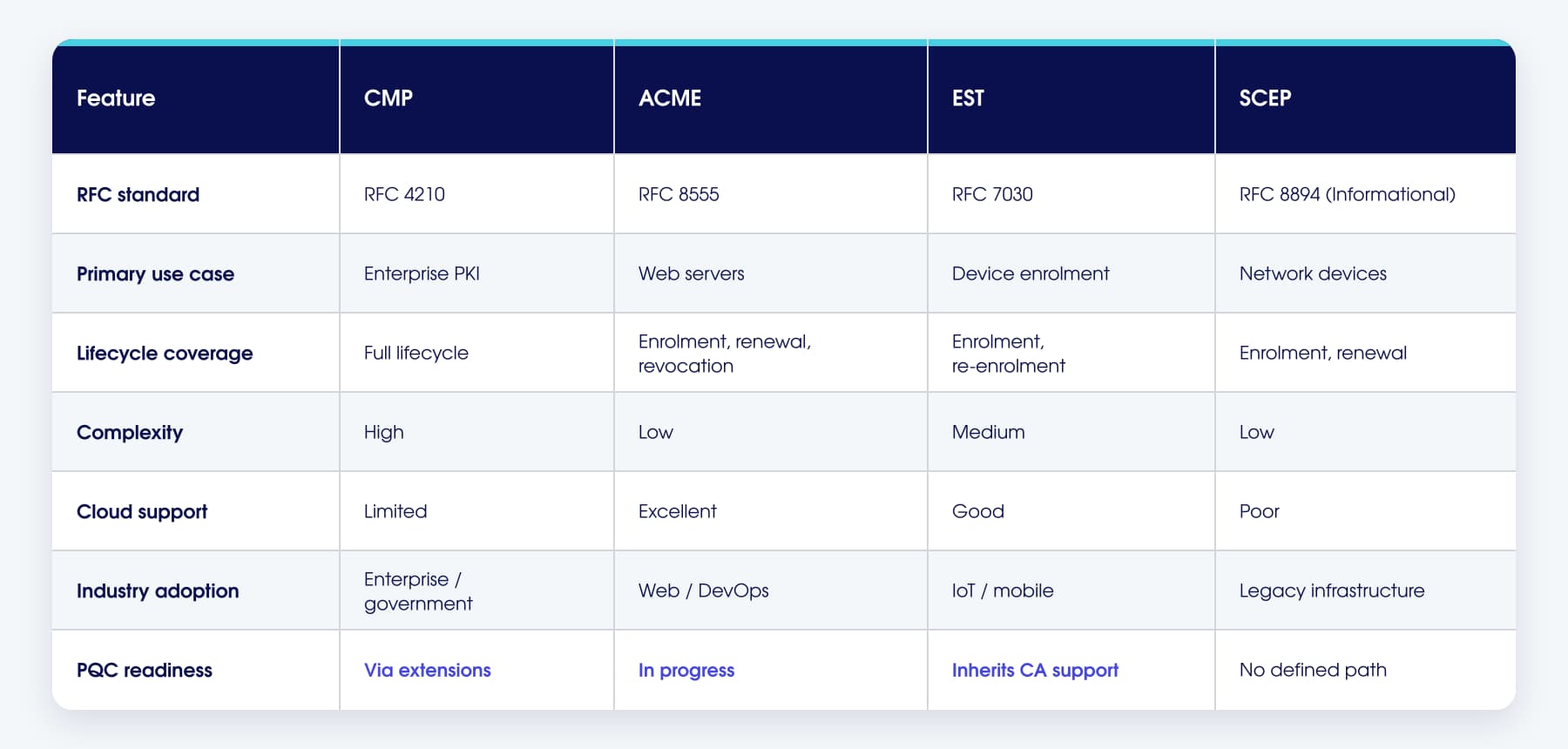
Summary of the comparison
- Lifecycle coverage is the row that usually decides it. CMP is the only protocol here that handles enrolment, renewal, revocation, key recovery and certificate update through one interface. Everything else requires a separate mechanism for operations it does not cover.
- Complexity is not a proxy for security. SCEP is the simplest to implement and the weakest of the four. EST is more work than SCEP largely because it requires a full HTTPS stack, and that requirement is what gives it a stronger security model.
- Cloud support tracks transport design. ACME's JSON-over-HTTPS model works anywhere HTTPS works. CMP's transport independence is an advantage in segmented and offline environments and a limitation in cloud-native ones, where there is rarely anything to be independent of.
- SCEP's standards position is worth noting. It ran for roughly twenty-five years as a widely deployed draft before RFC 8894 published it as Informational. It is still not standards-track, which matters if your compliance framework asks what standard a protocol conforms to.
- PQC readiness is the row to watch. Larger post-quantum keys and signatures put pressure on protocols designed around smaller payloads. CMP and EST have defined paths. SCEP does not, which is one more reason to treat it as transitional.
Certificate Management Protocol (CMP)
The Certificate Management Protocol, standardised in RFC 4210, provides comprehensive certificate lifecycle management for enterprise PKI environments. CMP distinguishes itself through self-contained security — messages include their own protection mechanisms independent of the transport layer, enabling true end-to-end security.
CMP supports complete lifecycle management: initial certificate requests, updates, renewals and revocations all through the same protocol. It handles both client-side and server-side key generation, accommodates multiple authentication methods, and supports key pair recovery when needed.
The November 2023 updates to CMP specifications introduced a Lightweight CMP Profile tailored for industrial applications, extending the protocol's applicability to resource-constrained environments. Commercial implementations include Nexus Certificate Manager, Entrust Security Manager, and EJBCA.
Strengths
- Full certificate lifecycle support
- Strong message protection
- Mandatory proof-of-possession
- Polling, nested messages, RA/CA separation
- Transport agnostic
Weaknesses
- More complex to implement
- Requires ASN.1 handling
- Not widely supported by commercial CAs
Automated Certificate Management Environment (ACME)
ACME, defined in RFC 8555, automates certificate lifecycle operations for web-facing services. Let's Encrypt pioneered ACME, proving that fully automated certificate issuance could work at massive scale — the protocol now underlies the majority of TLS certificates issued globally.
ACME's strength lies in its automation of domain control validation through challenge-response mechanisms. The HTTP-01 challenge verifies control by placing a file on the web server. DNS-01 proves control through DNS record creation. TLS-ALPN-01 uses the TLS handshake itself for validation.
Originally designed for public web certificates, ACME is increasingly adopted for internal PKI. Many enterprise certificate management platforms now support it, and the Chrome Root Program has required new CA applicants to support at least one automated issuance and renewal solution since 2024. Manual enrolment is no longer viable for new public PKI.
Strengths
- Designed for automation at scale
- Strong security via JWS, replay prevention, and domain control validation
- Simple JSON/HTTPS interactions
- Excellent tooling (Certbot, win-acme, acme.sh)
Weaknesses
- Primarily focused on TLS server certificates
- Limited lifecycle operations compared to CMP
- Domain validation model doesn't map cleanly to device identity
Enrolment over Secure Transport (EST)
EST, defined in RFC 7030, provides a simpler alternative to CMP for certificate enrolment. It uses HTTPS as its transport, leveraging TLS for security rather than implementing protocol-level protection. This design trades CMP's flexibility for implementation simplicity.
EST suits environments where TLS infrastructure already exists and end-to-end message protection isn't required. It's commonly used for device certificate enrolment in enterprise networks, particularly for mobile device management and IoT deployments where simpler protocols reduce implementation complexity.
Strengths
- Strong security (TLS mutual auth, PoP, confidentiality/integrity via HTTPS)
- Supports enrolment, re-enrolment, CA cert retrieval, server-side keygen
- Good fit for modern devices with HTTPS stacks
Weaknesses
- More complex than SCEP (multiple endpoints, more complex structures)
- Requires full HTTPS/TLS stack, which is heavy for constrained IoT
- Less flexible than CMP
- Adoption still growing; not universal on legacy hardware
Simple Certificate Enrolment Protocol (SCEP)
SCEP emerged in the 1990s for network device certificate enrolment. Despite never achieving formal standardisation beyond an informational RFC, SCEP became widely deployed in network infrastructure — routers, switches, VPN concentrators, and similar equipment often support only SCEP.
SCEP uses HTTP transport with CMS (Cryptographic Message Syntax) for message protection. Its design reflects network device constraints: limited cryptographic capabilities, simple authentication requirements, and the need to work across vendor equipment.
While SCEP remains necessary for legacy equipment, its age shows in security limitations. Newer deployments typically favour EST or CMP where possible, reserving SCEP for devices that support nothing else.
Strengths
- Very simple to implement
- Supported by routers, switches, firewalls, MDMs, and embedded devices
- Lightweight and stable
- Good for environments where device capabilities are limited
Weaknesses
- Weaker security model
- Limited functionality: basic enrolment and renewal only
- Outdated cryptography in many implementations
- Not standards-track — RFC 8894 is Informational, not a standard
- Being replaced by EST in modern ecosystems
Choosing the right protocol
Selecting the right certificate management protocol is rarely a binary choice. Most enterprise environments require at least two protocols running in parallel, each serving a different segment of the infrastructure. The decision comes down to what you are issuing certificates to, how much automation you need, and what your existing estate looks like.
Use ACME when you are managing TLS certificates for web servers, load balancers, reverse proxies, or any internet-facing service where domain control validation is appropriate. ACME is the clear choice for DevOps and cloud-native environments where certificates need to be issued, renewed and replaced without human intervention. Automation is now a condition of entry to the Chrome Root Store rather than a differentiator, and adoption is accelerating across both public and internal PKI.
Use CMP when you need full certificate lifecycle control across a diverse enterprise estate. CMP handles initial enrolment, renewal, revocation, key recovery and certificate updates within a single protocol. It is the strongest option for organisations running complex PKI hierarchies with multiple certificate profiles, particularly in government, defence and regulated industries where transport-layer independence and end-to-end message protection are requirements rather than preferences.
Use EST when you are enrolling modern devices that support HTTPS but do not need the full lifecycle capabilities of CMP. EST works well for mobile device management, IoT deployments, and environments where mutual TLS authentication is already established. It offers a practical middle ground between SCEP's simplicity and CMP's comprehensive feature set.
Use SCEP when you are supporting legacy network infrastructure — routers, switches, firewalls and VPN concentrators that were built with SCEP support and have no EST or CMP client available. SCEP remains essential in many estates, but it should be treated as a transitional protocol. Where possible, plan a migration path toward EST for devices that support it.
AD CS's lack of native support for ACME, EST and CMP is one of its most significant limitations for modern environments, effectively restricting organisations to SCEP and manual web enrolment. Our guide to AD CS in modern IT explores how this protocol gap affects organisations and what the replacement options are.
Protocol comparisons head to head
ACME vs EST
Both are modern, both use HTTPS, and the distinction is what identity means in each.
ACME proves control of a domain. EST proves possession of a credential. That difference determines where each fits: ACME for anything addressable by DNS name, EST for anything that has a device identity but no meaningful domain.
Choose ACME for web servers, load balancers, reverse proxies and cloud-native workloads. The tooling is mature, the automation is genuinely hands-off, and domain control validation maps cleanly to what you are securing.
Choose EST for devices enrolling with a client certificate or a manufacturer-installed credential. EST also supports re-enrolment, CA certificate retrieval and server-side key generation, none of which ACME addresses.
The two are not really competing. Most enterprises end up running both, with ACME covering the service estate and EST covering the device estate.
SCEP vs EST
The closest comparison of the four, because EST was designed to replace SCEP.
EST does the same job with a better security model: mutual TLS authentication, confidentiality and integrity from HTTPS rather than CMS, and support for re-enrolment and CA certificate retrieval. SCEP's shared-secret challenge password and its reliance on older cryptographic defaults are the weaknesses EST was written to address.
Choose EST wherever the device supports a full HTTPS stack. This is the right answer for anything procured in the last several years.
Choose SCEP when the device supports nothing else. That remains a large population — routers, switches, firewalls and VPN concentrators with long service lives and no upgrade path.
Treat SCEP as transitional. Support it where you must, avoid it in new procurement, and require EST or better in device specifications going forward.
SCEP vs ACME
These are rarely genuine alternatives, and organisations that compare them are usually asking whether ACME can replace SCEP across a device estate. Generally it cannot.
ACME validates domain control. Network devices, embedded systems and managed endpoints often have no domain name, no web server and no route to serve an HTTP challenge. The validation model does not fit.
Choose ACME for anything with a DNS name and an internet-facing service.
Choose SCEP only where the device supports nothing better — and EST is the target to migrate towards, not ACME.
The exception is MDM-managed endpoints, where some platforms now support ACME for device certificates. Where that option exists it is worth taking, though support remains uneven.
CMP vs the others
CMP is the only one of the four that does everything, and the only one most organisations decide against.
It handles enrolment, renewal, revocation, key recovery and certificate update in a single protocol, with message-level protection independent of the transport. In segmented networks, offline environments and anywhere the transport cannot be trusted, that independence is the reason to choose it.
The cost is implementation effort. ASN.1 encoding, richer message structures and limited support across commercial CAs and client tooling all make CMP harder to adopt than any of the alternatives.
Choose CMP when you need full lifecycle control across complex hierarchies, when transport-layer independence is a requirement rather than a preference, or when you are operating in government, defence, telecommunications or industrial environments where it is already established. The Lightweight CMP Profile has made it considerably more viable for constrained industrial deployments.
Choose something else if your requirement is enrolment and renewal rather than full lifecycle management. ACME or EST will deliver that with a fraction of the effort.
The short version
- Web and cloud services — ACME.
- Modern devices with an HTTPS stack — EST.
- Legacy network hardware — SCEP, with a migration path to EST.
- Full lifecycle control, or environments where the transport cannot be trusted — CMP.
Most enterprises need at least two of these running in parallel. The question is not which protocol to standardise on, but which platform can support all of them from one place.
What changes in June 2026
A separate Chrome Root Program change takes effect on 15 June 2026: publicly trusted TLS certificates will be limited to server authentication only, with the clientAuth Extended Key Usage removed.
Organisations currently using public certificates for mutual TLS or client authentication will need to move those use cases to private PKI. That is a protocol question as much as an architectural one, because device and user enrolment at scale requires EST, CMP or SCEP rather than the ACME workflows that served the public certificates being replaced.
If mTLS appears anywhere in your estate, it is worth auditing now which certificates carry clientAuth and where they came from.
Implementation considerations
In practice, effective certificate management means deploying a platform that supports all four protocols from a single management interface. Keyfactor Command is one example of a platform that natively supports CMP, ACME, EST and SCEP alongside integrations with Microsoft AD CS, EJBCA and public certificate authorities. This multi-protocol capability eliminates the need for separate enrolment systems per protocol and provides a unified view of your certificate estate regardless of how each certificate was issued.
When planning a deployment, consider your CA architecture first. Some protocols require specific CA configurations — CMP's proof-of-possession mechanisms and EST's mutual TLS authentication both impose requirements on the issuing CA that need to be designed in from the start rather than retrofitted. Unsung's PKI Consultancy service covers protocol selection as part of broader architecture design, ensuring the protocols you choose align with your CA platform, security policy and operational workflows.
Performance under enterprise load
Protocol performance varies significantly at scale. ACME's lightweight JSON-over-HTTPS design makes it exceptionally efficient for high-volume issuance — environments processing thousands of certificate renewals per day will see minimal overhead. CMP, by contrast, carries more message-level processing due to its ASN.1 encoding and self-contained security, which can increase latency per transaction. However, CMP's richer feature set often reduces the total number of protocol interactions needed to complete complex operations such as key recovery or certificate updates.
EST sits between the two in terms of overhead, with TLS session establishment being the primary performance factor. SCEP is lightweight by design but lacks the throughput optimisations of modern protocols.
For most enterprise deployments, protocol performance is not the bottleneck — HSM signing speed, CA database performance and network latency between clients and the registration authority have a far greater impact on end-to-end issuance times. Organisations processing more than 10,000 certificates per day should factor load testing into their PKI Design & Build project to identify genuine constraints before they affect production.
Frequently Asked Questions About Certificate Management Protocols
What is a certificate management protocol?
What is the difference between CMP and ACME?
Is SCEP still relevant?
When should I use EST instead of SCEP?
Can I use multiple certificate management protocols at the same time?
What does Chrome's Root Programme mean for certificate management protocols?
How do certificate management protocols relate to post-quantum cryptography?
How Unsung Helps with Protocol Implementation
Unsung brings deep expertise across certificate management protocols. We help organisations evaluate their requirements and select appropriate protocols for different use cases within their environment.
Our implementation services deploy and configure protocol support across certificate management platforms including Keyfactor, Microsoft ADCS, EJBCA, and others. We integrate certificate protocols with existing infrastructure—ensuring automation works reliably across diverse systems.
Contact Unsung to discuss which certificate management protocols fit your organisation's needs.